Across Québec, families are continuing to face growing uncertainty about the access of childbirth services. Obstetrics clinic closures, stalled birthing center projects, regional service gaps, and ongoing staffing shortages are forcing more families to travel father from home or navigate increasingly limited options during pregnancy.
Recently published in La Tribune, the following open letter by Sarah Landry, Coordinator of the Movement for Autonomy in Childbirth (MAE), argues that these recurring issues aren’t only the result of logistical and financial barriers. There’s a broader lack of political commitment toward perinatal care in Québec. At the same time, she emphasizes cost-effective solutions that families and professionals have been advocating for years.
Below, Landry reflects on the current state of childbirth services Québec and why meaningful action and change can no longer wait.
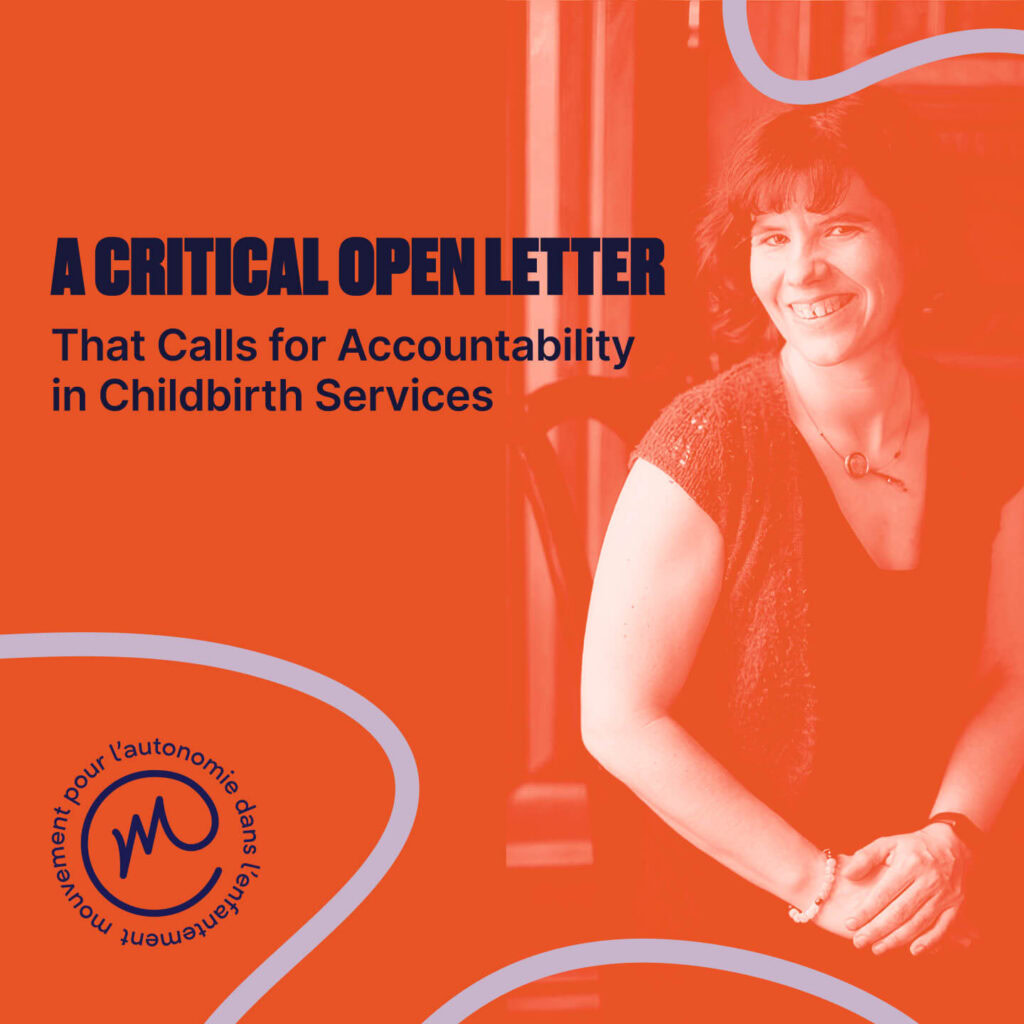
Open Letter — Innovations in Health, But Not for Childbirth
By Sarah Landry, Coordinator of the Movement for Autonomy in Childbirth (MAE)
Obstetrics clinics are closing in Châteauguay, Victoriaville, Saint-Eustache, and Québec City.
The Family-Birth Unit at Notre-Dame Hospital, representing a $25 million public investment, was abandoned just months after opening.
There is no obstetric care available in certain regions during the summer months, notably in Témiscouata-sur-le-Lac, for two summers in a row. No improvement is expected in 2026.
The development of the full range of services necessary for childbirth has been put on hold for years in Laval, Longueuil, Sept-Îles, Salaberry-de-Valleyfield, Pointe-Saint-Charles, and the Magdalen Islands.
This doesn’t even account for the forced and sudden closures of existing services, like the one in Lévis last January.
Each time, it’s the same story: staff shortages, unsuitable buildings, excessive costs, insufficient budgets, and more.
But each time, what’s really at issue is a lack of political will.
The affected families learn the news through the media. And all they’re told is to find somewhere else to give birth. Further away. In an already overwhelmed hospital.
Meanwhile, solutions that families value already exist, but are systematically dismissed.
For example, we know that birthing centers reduce unnecessary medical interventions. They cost the healthcare system less by easing care pathways. Likewise, midwives can follow a pregnancy from beginning to end and safely support home births in most cases. Communities, families, and midwives have already done the groundwork: we know what it takes to open birth centers outside hospitals.
Similarly, the recent national conference on midwifery practice proposed concrete strategies for training and retaining more midwives.
But the funding needed to make this happen never arrives.
How can we explain the abandonment of these solutions?
This is a question that deserves a real answer. For years, we’ve heard about home care and at-home hospitalization. We’re told it’s more humane, more effective, less expensive, and that it relieves pressure on hospitals. We invest in it. We promote it. Very well.
But when it comes to childbirth, this reasoning suddenly disappears?
Giving birth at home or in a birth center is exactly that. It’s effective, humane, and safe care. It costs less. And it responds to what many families are asking for.
For this option to be truly accessible, three things are needed: enough midwives, services available throughout the province, and adapted regulations that fully recognize alternative ways of giving birth. Three conditions Québec still refuses to bring together.
Twenty-seven years after the legalization of midwifery practice, we are still far from that goal.
In 2008, the government committed to ensuring that 10% of pregnancy care would be provided by midwives by 2018. By 2025, that number had only reached 5.3%. Halfway there.
Should we understand that childbirth is not considered real healthcare in the eyes of the state? That this moment — one of the most important in a person’s life — does not deserve the same effort, the same commitment, the same imagination invested elsewhere in the healthcare system?
Every passing month means more poorly monitored pregnancies, more families forced to leave their region to give birth, more exhausted midwives leaving the profession, and more birthing centers closing before they even have the chance to open.
The status quo is a choice. It’s time to make a different one.
Landry’s letter raises an important question: why do childbirth services continue to be treated as secondary in Québec’s healthcare system, despite the growing needs of families?
As closures continue and regional inequities deepen, the solutions being proposed aren’t new. Midwifery-led care, birthing centers, expanded community-based services, and the like, have long been recognized as safe, sustainable models of care. Our communities, from healthcare professionals to families and advocacy groups, have already done so much of the work needed to identify what needs to change. What we need now is the political will to invest in these services across Québec, so we can ensure all families can experience childbirth with autonomy and safety.