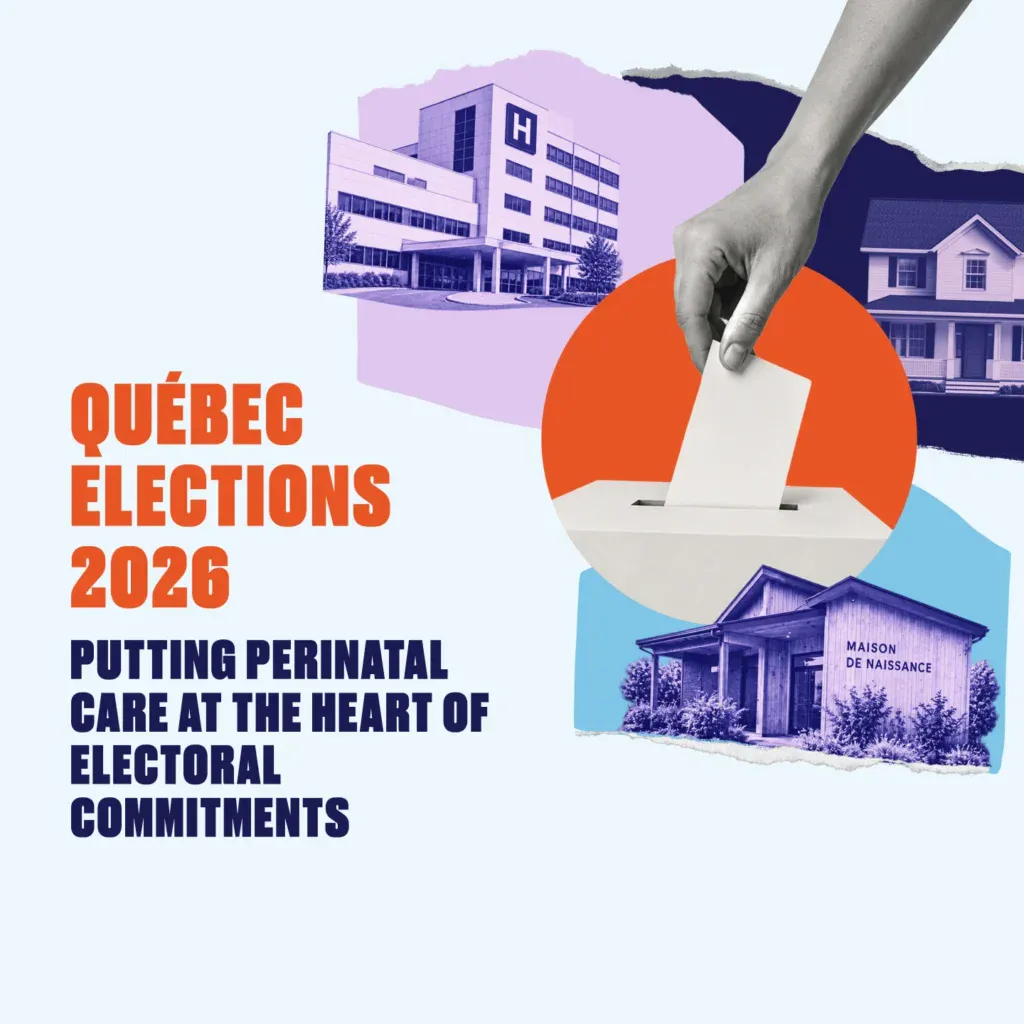
During the election campaign that began in August 2026, healthcare and the state of public services were among civil society’s major concerns. For the Movement for Autonomy in Childbirth, this was an opportunity to inform the public and propose clear, simple, and affordable solutions to political parties to make the healthcare system more resilient.
This work built on a year of citizen mobilization in Québec, during which several issues related to perinatal care came to the forefront, notably during the Estates General for Midwifery Practice in November 2025.
The elections are now behind us. We want to look back on this period, which saw a flurry of activity in both political proposals and media coverage.
Phase 1: Informing the Public — “One Birth. Many Ways to Experience It.”
At the start of the election campaign, we chose to focus on the needs expressed in our guidance booklet, particularly families’ need for information. The findings were striking: thousands of Québecers were unaware that they had more than one option for pregnancy care.
This lack of information undermines the right to information and compromises the ability to make an informed choice. We therefore launched a public information campaign on our social media platforms called “One Birth. Many Ways to Experience It.”
The goal was to reach a new audience and:
- Debunk misconceptions through posts such as “I Didn’t Know” and “What We Hear.”
- Increase public knowledge through “True or False?” posts.
- Encourage people to share their experiences through “Share Your Story With Us.”
At the same time, we reached out to the media and secured opportunities to discuss this lack of information. You’ll find links to related articles and interviews at the end of this article.
This initial phase had the desired impact: drawing attention to the issue and raising public awareness. There are many ways to experience pregnancy and childbirth, and insufficient public education about these options prevents people from making fully informed choices.
Phase 2: Seeking Commitments from Political Parties — “A Matter of Choice and Efficiency”
As the campaign progressed, our goal was to secure a crucial commitment: the government must inform the public about the different options for pregnancy and childbirth care.
Starting September 22, 2026, we contacted political parties to present our requests for commitments. We proposed simple measures that could be implemented in the short term.
We highlighted the connections we see between access to information and the unfortunately frequent disruptions to obstetric services. We outlined concrete actions that the next government could implement quickly, while leaving room for more ambitious demands in the weeks and months ahead.
Here are the commitments we requested:
- Launch an information campaign for the health and social services network: Mandate the responsible organization, currently Santé Québec, to deliver a province-wide information campaign for all staff in the health and social services network (RSSS). The aim is to ensure staff know about all options for pregnancy and childbirth care and can support families in making informed choices during the perinatal period.
- Redesign MaGrossesse: Enhance the MaGrossesse platform so that it becomes a comprehensive source of information about all childbirth and perinatal care options offered through the RSSS and helps families make informed decisions.
- Support sexual education: Ensure funding for community organizations and professionals who can support teachers in delivering sexual education, so that every young person understands the diversity of birth experiences and family realities.
We also reached out to the media again to bring our requests to political parties into the public conversation. We wanted to draw attention to perinatal issues and highlight some of the ideas discussed at the Grand Gathering last February.
With the healthcare system under pressure, expanding midwifery practice is one way to diversify available services and use resources more efficiently. This is why the government must inform the public about the options available and improve access to all three birth settings (hospital, birth centre, and home) throughout Québec.
Phase 3: Mobilizing Our Members in the Final Stretch
After raising public awareness and presenting concrete actions that a future government could commit to implementing quickly, we moved on to the third phase: mobilizing on the ground.
On September 23, 2026, we sent a special newsletter to our members with one objective: to equip them to take action. We knew many were eager to get involved and advocate for our requests with candidates in their ridings.
The tools and opportunities shared included:
- A one-page document from The Movement summarizing our requests for commitments and the campaign context.
- A special guide, How to Approach Your Local Candidates, to help members present those requests to candidates in their ridings.
- An invitation to share our social media posts and help them reach more people.
This was the final (and most important) phase before the election in working toward our main objective: bringing perinatal issues to the forefront. To make informed choices, people first need to know that different options exist.
We are proud to have contributed to the conversation this year alongside other civil society organizations. It was a valuable learning experience that will inform our work in future election campaigns.
What’s Next?
The election may be over, but The Movement’s mobilization continues. This campaign is part of a broader strategy guided by our theory of change.
We will continue to inform pregnant people and those supporting them about their rights and available options and provide tools to help them act on that knowledge. We also aim to strengthen the ability of local groups across the regions to take action, support citizen mobilization, and bring experiences from their communities to the attention of decision-makers.
By combining information, mobilization, and advocacy, we hope to contribute to lasting changes in services, policies, and the broader culture of childbirth in Québec.
Our goal goes beyond providing information: we want people to be able to exercise their rights and make their own choices. Autonomy in childbirth is a choice we make as a society!
Explore the Articles and Interviews