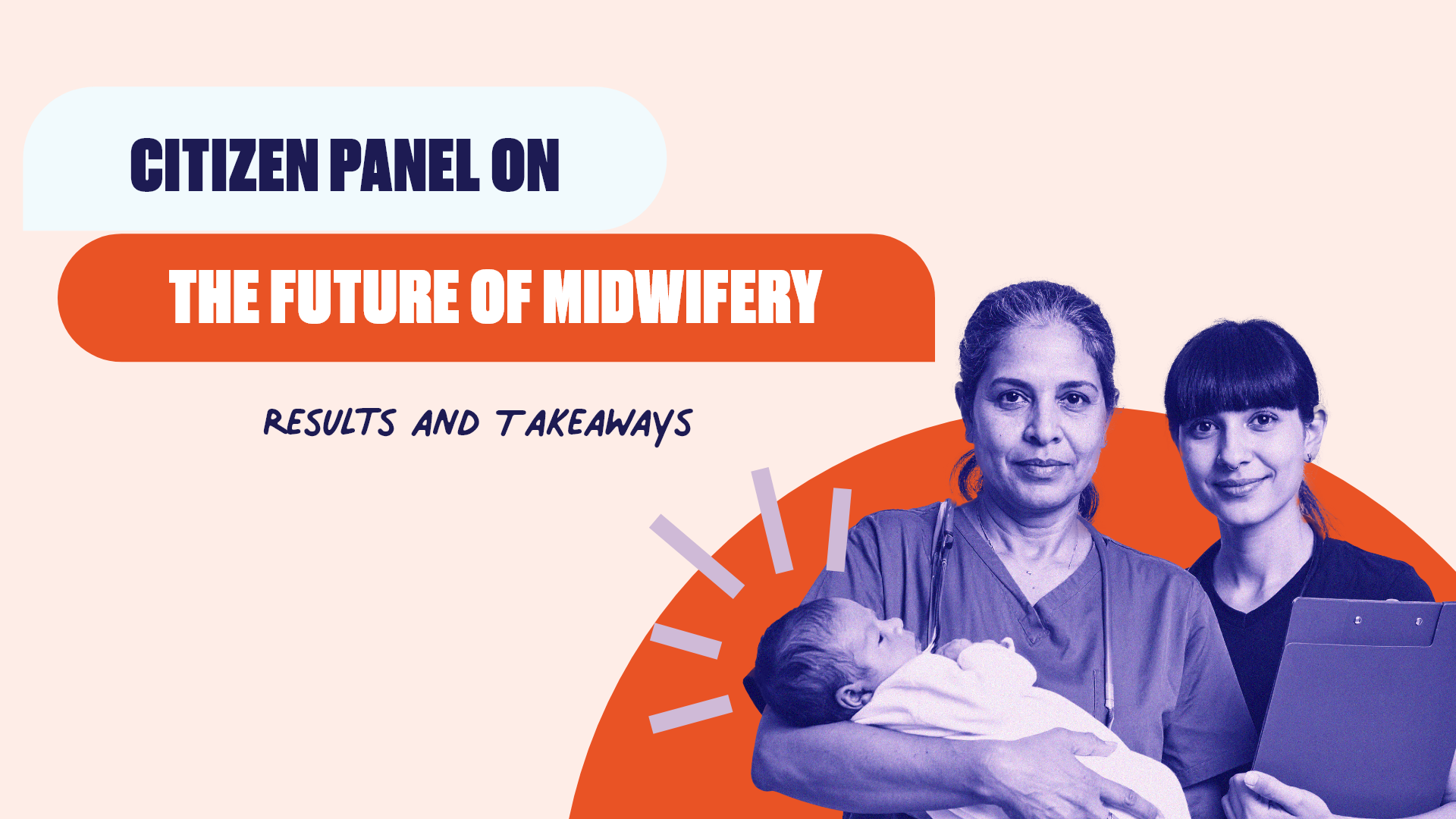
This year, Québec launched one of the most in-depth public consultations on childbirth and midwifery since the province legalized the practice in 1999. These efforts, carried out by the Institut du Nouveau Monde (INM), come at a critical time for the profession, when public interest is growing, but services remain unevenly distributed.
Funded by the Ministry of Health and Social Services, three major initiatives structured this consultation conducted by the Institut du Nouveau-Monde: a citizen panel made up of randomly selected residents, a survey of families using or familiar with midwifery services, and a survey of midwives, including students and former practitioners. These cross-perspectives reveal both shared priorities and major gaps.
These findings not only validate long-standing concerns but also serve as a call for action. We spoke with Sarah Landry, General Coordinator of the Movement for Autonomy in Childbirth and Pregnancy, to unpack what the data reveals and explore the next steps.
Families Praise Midwives (and Want More)
One of the most striking findings of the survey is that satisfaction with midwifery services is exceptionally high. Over 90% of families reported being very satisfied with their care, and 93.8% would recommend midwifery services to others.
Sarah explains, “The most highly valued qualities are the warm and compassionate approach, respect for physiology and autonomy, continuity of care, and perceived safety in the birthing center.”
Birth centres stood out as a place where families felt especially safe and supported, a stark contrast with hospital environments. Respondents also noted the importance of home visits and the involvement of partners and siblings in the journey in creating a sense of community around childbirth.
The Problem of Unequal Access
Despite this remarkable satisfaction rate, access to midwifery services remains a major issue. In Quebec, midwives only support about 8% of pregnancies. Families often face waiting lists, long distances to travel, or a complete lack of services in their region. According to Sarah, the surveys “reveal deep inequalities.” Furthermore, the Movement knows that groups in regions far from major centers are requesting birthing rooms and locations appropriate to their large territories.
The survey found that 12.5% of respondents traveled an average of 1.5 hours to access care, with some traveling up to six hours. Entire regions, such as Laval and Côte-Nord, have no midwives at all.
The lack of visibility of the profession is particularly evident in the way people discover services. Sarah reports that according to the survey, “52% of users discovered midwifery through word of mouth.”
What the Survey Data Agrees On
While the surveys engaged very different groups (citizens, families, and professionals), many of their conclusions aligned. Across all three, participants emphasized the need for better access, stronger public understanding, and a commitment to midwifery’s guiding principles.
“Three themes recur strongly,” Sarah explains. “Accessibility: Families, midwives, and citizens are demanding more services in all regions, and accessibility for the most vulnerable women. Visibility and recognition: The practice remains largely unknown, and myths persist, including in the medical community. The philosophy of the practice: continuity, decision-making autonomy, and respect for physiology are the foundations to be preserved in future development.”
She adds that the citizen panel “sums up this consensus well by stating that midwives should become the gateway to perinatal care in Québec, to meet the majority of front-line needs. To achieve this, however, it would be necessary to “increase the number of midwives and develop enough birthing places throughout Quebec.”
Midwives Sound the Alarm on Medicalization
The consultation process also surfaced growing tension within the midwifery profession. While midwives remain dedicated to the philosophy of their work, many express concerns about a shift toward medicalized care.
Sarah points to the survey findings, which indicate that “more than 30% of midwives consider it ‘difficult’ to respect the physiological process,” and “25% consider it difficult” to support women’s autonomy and power in care decisions.
She explains that this stems from the pressure to explain more and more tests, examinations or possibilities: “Several midwives say they feel professionally inferior and denounce the pressure they are under to comply with the decisions of medical teams, even when these contradict the choices of families.”
This concern isn’t limited to practitioners, Sarah continues, “Many families have been expressing to us for several months… they too perceive a loss of autonomy in their care and are concerned about seeing the midwife’s approach moving closer to hospital standards.”
In fact, she notes that earlier this year, “a group of citizens met specifically to reflect on the medicalization of midwifery profession and to seek solutions collectively. This meeting confirms that both professionals and users share the concern, which deserves to be discussed and explored further during the Grand sommet des états généraux de la pratique sage-femme.”
Access and Support Must Go Hand-in-Hand
Despite agreement on larger objectives, families and midwives voiced different short-term concerns. “Families and citizens emphasize access and information, including a lack of understanding of the practice itself,” Sarah explains. “While midwives highlight their working conditions: overwork, long call times, and lack of interprofessional recognition.” They present the expansion of midwives’ scope of practice as a solution to accessibility, while it is also a solution to flexibility in working conditions.
Far from being at odds, these differences point to the need for short-term changes. “These differences are not contradictory,” Sarah says. “They demonstrate that we must both increase the supply in all regions of Quebec and improve working conditions to retain midwives. We must also raise public awareness of the benefits of the care they provide and expand the scope of practice to limit certain transfers of care.”
The data also revealed that the barriers to midwifery care are not just practical; they’re systemic. “The results reveal a double injustice,” Sarah notes. “Territorial: Access depends on postal code. Some families have a birthing center nearby; others have to travel several hours or forgo it altogether. Structural: The medical paradigm remains prevalent. Midwives report pressure to comply with the decisions made by other professionals, which limits their clinical autonomy and the application of their principles.” Furthermore, their scope of practice is limited, partly as a result of concessions made in the 1990s to achieve the legalization of midwifery.
She adds that the Citizens’ Panel “clearly states that midwives are misunderstood, including within the healthcare system,” and that the lack of awareness is “fueled by myths and weak media presence.” Put simply, “The right to choose the location and model of care remains theoretical for many pregnant women and people, due to a lack of real access.”
Moving Forward: A Vision Aligned with the Movement
The results from these consultations will directly inform the États généraux de la pratique sage-femme, a provincial summit scheduled for Fall 2025. “The purpose of the major summit is to adopt recommendations that will be addressed to various organizations, including the Quebec government, the Order of Midwives, the Ministers of Health and Higher Education, etc,” Sarah explains.
Community members, professionals, and families alike will play a role in shaping those recommendations. “We must jointly consider recommendations that could lead to an increase in the supply of midwifery services, an increase in the number of birthing locations, and a diversity of midwifery service users,” she continues.
The Movement for Autonomy in Childbirth and Pregnancy sees these findings as a validation of the work they’ve been doing for years. “These results confirm the core mission of the Movement,” Sarah says. “Every woman and every pregnant person has the right to choose their professional and their place of birth.”
As the consultations conclude and the next phase begins, Sarah reminds families, midwives, and advocates that their voices are heard and reflected in the data: “The message is clear: you are not alone in your demand for choice, autonomy, and respect. The data confirms it: midwifery is a valued and safe. It is largely unknown, and should be more widely understood so that everyone can make their own choices.”
The objective is unequivocal: “Together, families, midwives, and allies, we must transform this social consensus into concrete political decisions: open new birthing centers adapted to the realities of remote regions and train and retain more midwives.” Sarah concludes, “Because giving birth where you want, with the people of your choice, is not a privilege. It is a societal choice that we must offer ourselves.”